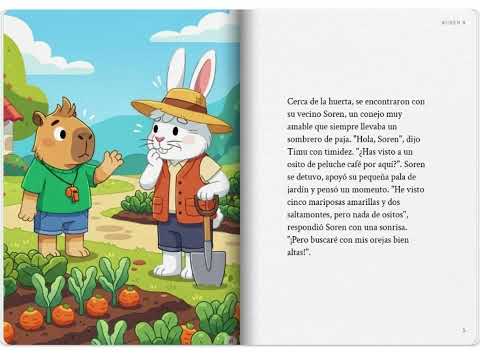
The Capybara Family - Interactive Children's Story

$E=mc^2$
$\int f(x) dx$
$H_2O + CO_2$
Story Library
Capybara 1

The Capybara Family 1

Initial coexistence protocol. A lesson about finding shared solutions and the value of loved objects.

LAUNCH

Capybara 2

The Capybara Family 2

Advanced interaction protocol. New adventures that reinforce collaborative learning in natural environments.

LAUNCH

Once upon a time there was a family of capybaras that lived happily on the banks of the Amazon River. One hot day, they discovered an island full of ripe melons. But there was a problem: the river current was too strong for the little ones. Working as a team with a friendly turtle, they formed a safe bridge. Thus, everyone shared the feast, learning that collaboration overcomes any obstacle.

The Narrated Story

Hear the story of the capybaras read aloud by the intelligent interactive narrator.

Capybara Wardrobe

Customize the capybara by touching the accessories to dress it up and make it elegant.

Logidias Multimedia System v2.4 | Active Protocols

LOGIDIAS Interactive Module

Familia Capibara: Zoology & Wetland Ecology

Educational & Scientific Guide

🔬 Scientific & Physical Foundations

Ecological simulation of semi-aquatic rodents, trophic food webs, and South American wetland conservation.

🕹️ User & Experimentation Guide

Manage water resources and explore herd dynamics across riverbank wetland biomes.

Frequently Asked Questions (FAQ)

Why is the capybara the largest rodent?

Grows up to 65 kg with specialized digestive cecum to graze wetland grasses.

What semi-aquatic adaptations does it possess?

Dorsally aligned sensory organs and webbed feet for efficient aquatic locomotion.

What is its ecological role?

Serves as a key herbivore and peaceful social facilitator within riparian habitats.

🔬 Related Interactive Simulators & Worksheets

Explore all worksheets ➔
MOD-17 • INTERACTIVE SCIENTIFIC EXTENSION & SELF-ASSESSMENT

Ecological Pyramid (10% Rule) & Logistic Carrying Capacity Calculator

📄 Open Solved Worksheet & Guide ➔
🎓 Elementary & Middle School Ecology🎓 High School Environmental Science Mathematical Principle & Governing Equations: En ≈ 0.10 × En−1  |  dN/dt = r·N·(1 − N / K)
10000
100
400

🎯 3 Self-Grading Practical Challenges (Instant Verification)

0 / 3
#1.By Lindeman's 10% trophic law, if aquatic plants capture 10,000 kcal of solar energy, how much transfers to primary herbivores?
#2.In the logistic population model, what happens when population size N equals carrying capacity K?
#3.What key anatomical adaptation helps the capybara thrive in semi-aquatic wetlands?